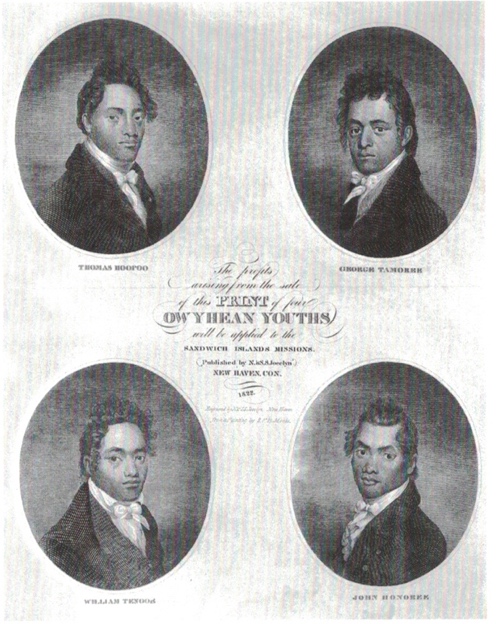
The Four Kanaka
Four Hawaiians Sailed on Thaddeus with First Missionary Company
Thomas Hopoo (Hopū), Wiliam Tennooe (Kanui), John Honoree (Honoliʻi), George Tamoree or Humehume (Kaumualiʻi also knowns as Prince George Sandwich)
These four men were among 20 Native Hawaiians educated at the Foreign Mission School in Cornwall, CT. Hopu, Kanui and Honoliʻi as mission assistants were part of the first company, returning to their homeland from New England, while Prince George was given passage on the same ship to Hawaiʻi as well. While on board ship, they taught ʻŌlelo Hawaiʻi (Hawaiian language) to the missionaries. Upon arrival in Hawaiʻi, Hopu and Honoliʻi, were instrumental in the success of the early mission movement in Hawaiʻi as they assisted and collaborated with the First Missionary Company, teaching ʻŌlelo Hawaiʻi to the missionaries and serving as interpreters and cultural liaisons. Kanui and Hopu initially were assigned in 1820 as tutors to Mōʻī Liholiho serving with the Thurstons and Dr. Holman in Kona.
John Honoliʻi’s importance to the success of the mission cannot be overstated, because he was the most devout Christian among the three Hawaiian mission assistants. He served primarily at the Kona Mission with the Thurstons and contributed to the Honolulu, Waimea Kauaʻi, and the Lahaina missions. He worked with fellow classmate and missionary, James Ely, in translating to ʻŌlelo Hawaiʻi the story of Joseph from Genesis.
Thomas Hopu left Hawai`i at age 13 in 1808, becoming shipmates with Henry ʻŌpūkahaʻia, with whom he became close friends. He was the first native Hawaiian to have ever preached in ʻŌlelo Hawaiʻi when he gave the farewell address at the commissioning service of the First Missionary Company held at Park Street Church in Boston on October 15, 1819. He was of great assistance to Rev. Hiram Bingham in the Honolulu mission and provided interpreting services to the Kauaʻi and Lahaina missions.
Wiliam Kanui served for about two years with the Kona missions and left the church for other pursuits, i.e., opening a school for children and ministering to Hawaiians who, like him, went to California during the Gold Rush. Kanui eventually returns to his faith and to Hawaiʻi. He is buried on the grounds of the Mission Cemetery at Kawaiaha`o Church.
Prince George Kaumualiʻi (son of the last king of Kauaʻi & Niʻihau), entrusted in the care of a ship’s captain by his father King Kaumualiʻi, was sent to New England at the age of 6. Years later, as a youth and on his own, he fought in the War of 1812 before enrolling in the Foreign Mission School in 1817. He reunited with his father when he returned to Kauaʻi on May 3, 1820, along with missionaries Samuel Ruggles and Samuel Whitney, both of whom established the third church in Hawaiʻi at Waimea, Kauaʻi. He played the Bass Viol on the Brig Thaddeus and at the first worship service in Honolulu at Kawaiahaʻo on April 23, 1820.